Showing posts with label Belgium story. Show all posts

Thursday, June 7, 2018

Insect observatory

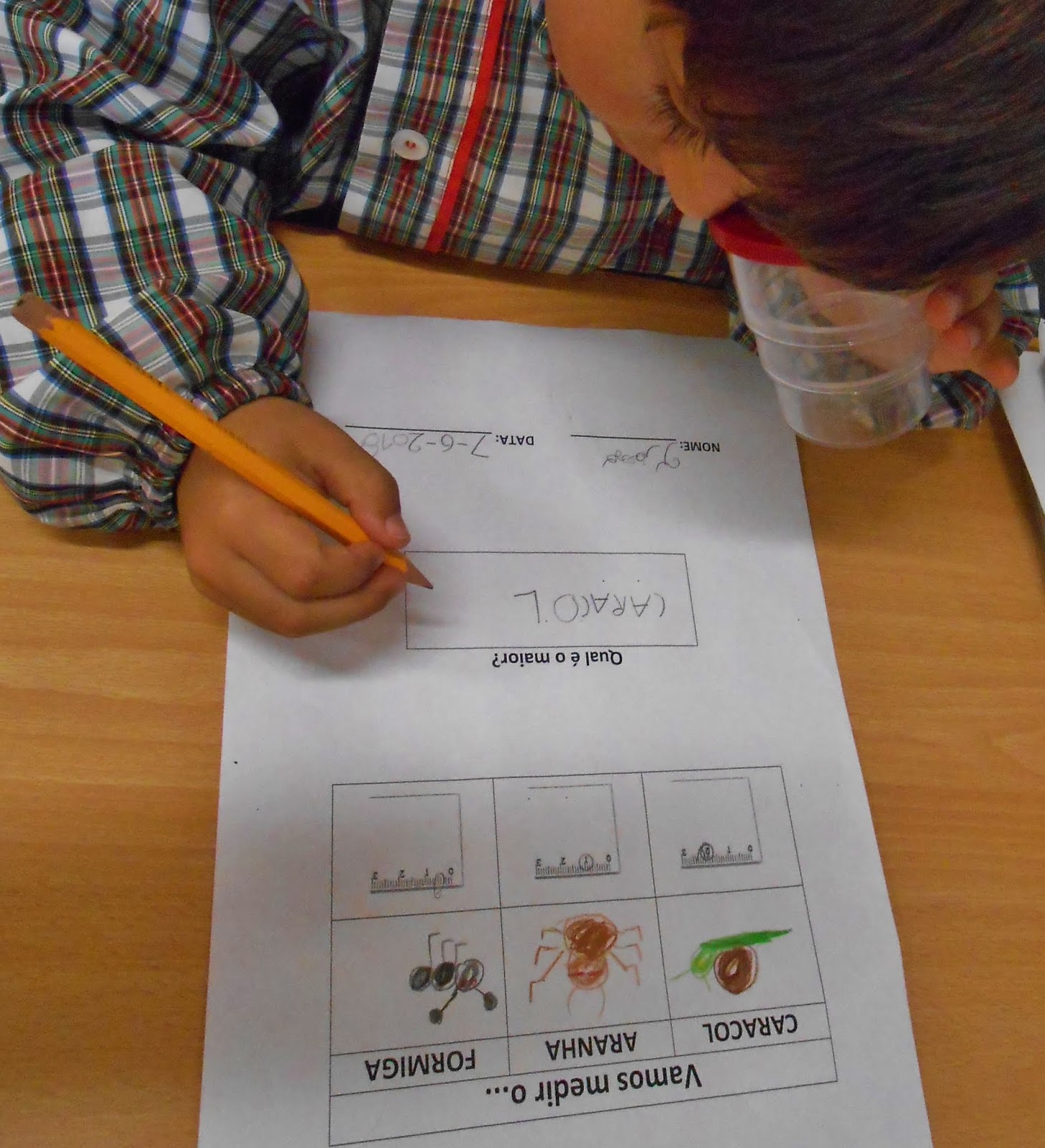
With a snail, a spider and a ant we made an insect observatory.
We put the small insects side by side and we observed them well and share the differences and similarities between them.

 UPS!!!! Where is the Spider?
 Inside the magnifying glass


  Look The ant, it seems so big!!


 - The snail has a shell and the ant is thin;
- The snail is larger than the ant and the spider;
- The ant is black, the snail is green and brown;

- The ant and the spider have legs but the snail crawls;
- The ant walks very fast and the snail is very slow. The spider does not move, because it is dead!

Ant has a problem

Trap to catch ants

We built a trap to catch ants. Do you know how? Well the antslove sugar and we... guess what?
 We mixed a little sugar with a little water in a lid...
... we put it out there in the playground 
and... after 15 minutes we had ants already

we got to count 6 ants: 2 little ants and 4 big ants.

Thursday, May 31, 2018

We made the characters of the story the problem of the ant...
 They are beautiful!!


 Look the ants!!
 The bees


The bees!
... the crickets!!
 So beautiful are our snails

and we built a beautiful mobil

Thursday, May 17, 2018

Thursday, May 10, 2018

Ant has a problem!!

The children of Correeira's Kindergarten made beautiful draws about the ant's story.


Friday, May 4, 2018

Floepje and water - Belgium sroty

THEME: HOW PURE IS OUR WATER?

CHILDREN AGE: 6-7 years

OBJECTIVES:
- The child is able to assess the purity of water. The child knows that we have to use and maintain water sparingly.
- The child is able to discuss how we can save nature.
- Measurement of liquid with the agreed unit of measurement. The child is able to compare the quantities (the amount of dirt on the filter).

USED MATERIALS, TOOLS: bottles for collecting water and snow, transparent cups, white coffee filters, magnifying glasses, papers, pencils.

PREPARATIONS: Teacher has to prepare the trips path to the river and to the sea. And organize other needed materials.

ACTIVITY:
Teacher reads the story "Lope (Floepje in Estonia) and water" to the children. Children tell together a the story with their own words and discuss the content of the story. Have children seen trash in the nature? How did it got there? What can we do to prevent garbage from getting into nature? What can children do to save water?


The teacher is telling that today we will compare the purity of water and to collect water we will go for a little trip. The teacher is explaining the objectives of the hike and agrees on the rules how to behave in hiking.


In front of the kindergarten the children gather snow for melting. They observe and touch - which is snow? Where it comes from? What it consists?


Then they hike to the riverside, where they take a water sample with bottle. They observe and describe the river and which is the river water at the moment, why is part of the river frozen and other part not?


Then they move to the seaside and take a sample of water from the sea. They observe the sea, compare it with river. Which is sea water, how is it with ice?


Back in kindergarten the children measure equal amount melted snow water, river water, sea water and tap water into transparent cups. They observe with naked eye and with magnifying glasses the water darkness and sort the cups according to the darkness of the water


The different waters will be poured through filters and then they examine the sediment left on filters. The children compare the amount of dirt left on filters.


In a joint discussion round they talk, what they found from water? Which from the water can drink and what not?


Thursday, May 3, 2018

Ant has a problem - Belgium story

THEME: WHITCH IS HEAVIER?

CHILDREN AGE: 3-4 years

OBJECTIVES:
- Experiments with scales. Exploring different scales and weighing methods. Weighing different objects. Whitch is heavier, whitch is lighter?
- Walk to the forest to explore anthill. Whitch is anthill in winter? Does snow give warmth to the anthill? Why you are not allowed to destroy anthill? Exploring pictures of ants (head, body, feet). Exploring pictures of anthill and its inside (tunnels, eggs, ants). What do ants eat? How they get food? How do they work? (carring objects that are bigger than they). How do they cooperate to help each other?
- Getting to know numbers 1-10; comparing (heavier-lighter).
- Making anthill with its inhabitants. Molding anthill.

USED MATERIALS, TOOLS:
Story "Ant has a problem". Scales, differents objects for scaling. Pictures of ants, anthills. Gouache colors, brushes, buttons, silk paper, modelling clay and modelling sticks.

PREPARATIONS:
The story has been told to the chidren. Other materials are put ready for the activity.

ACTIVITY:
Teacher tells the story to the children. They discuss about it. We explain the importants of helping others and sharing with others. Thinking together, can we lift and move heavy and big objects? Exploring scales. Exploring how they work? How do we know whitch one is heavier?


Whitch is heavier and whitch is lighter? How can we determine the objects heaviness?


During the testing the children understand that heavier object falls down, lighter rises up. Sometimes we can tell by looking or weighing by hand how heavy the object is, but its always not true. It is more secure to use scale, you get more accurate answer.

Weighing different sizes numbers it turned out that bigger number weighs more. In the same time two numbers (3+3 or 2+2 or 4+4) weighed the same as one number (6; 4; 8); they were equal weight.


Walk to the forest to see anthill. We expore anthill in winter. What changes have occurred since spring and autumn in anthill. As we did not see the ants, we realized that they were sleeping in the winter. Snow gives the nest warm and protection.
 

When we came back from the forest we expored ants life and doings from the pictures. We expored the inside of anthills, where are the tunnels, where are the eggs, where the ants.

The children draw a picture of anthill with tunnels. When the paint dried, they glued ants from buttons and eggs from wrinkled silk paper.


The children were enthusiastic about the ants and anthill, and wished to make something more exciting. So we decided to model nice anthills and illustrate them with modelling sticks.